

A COLLECTION OF THE FREAKIEST FUNGI ON EARTH!
Witch’s Butter — The Golden Goo of the Forest

Tremella mesenterica
Imagine a damp October morning when a glossy yellow mass clinging to a dead branch catches your eye. It looks like enchanted slime or the leftovers from a witch’s midnight potion. Witch’s butter (Tremella mesenterica) is a remarkable jelly fungus with an unusual appearance, a surprising survival strategy, and a name straight out of a Halloween storybook.
Species Range and Habitat
Witch’s butter has a broad distribution in temperate regions and is recorded in North America, Europe, and elsewhere. It is often seen on dead or recently fallen hardwood branches, including oak and other broad-leaved trees. It commonly appears during damp weather and can fruit in more than one season. Although it seems to grow directly from dead wood, it is a parasite of certain wood-inhabiting crust fungi, including fungi in the genus Peniophora.
Physical Features
The fruiting body is golden yellow to orange-yellow, with irregular folded lobes that resemble a tiny brain or crumpled ribbons. When wet, it is shiny, soft, rubbery, and gelatinous. It can shrink into a thin, darker crust during dry weather, then absorb water and swell again when moisture returns.
Fun Facts
- A witchy name: folklore helped attach supernatural associations to unusual growths on doors and branches.
- A secret fungal target: it parasitizes other fungi living in wood rather than simply feeding on the branch itself.
- The ultimate comeback artist: its fruiting body can shrivel when dry and rehydrate after rain.
- Not every yellow jelly is the same species: other jelly fungi can look similar, so substrate and microscopic features can matter.
Nature-lover’s challenge: Inspect damp fallen hardwood branches for bright yellow jelly fungi. Photograph them and see how they change after rain.
References and further reading
Dead Man’s Fingers — The Forest’s Creepiest Guests
Xylaria polymorpha
A cluster of dark, knobbly shapes poking from a rotting stump can look like the fingers of a long-buried creature reaching toward the surface. Dead man’s fingers (Xylaria polymorpha) is a macabre-looking fungus and a dedicated recycler of dead wood.
Species Range and Habitat
Dead man’s fingers is found in temperate woodland regions, including parts of North America and Europe. It is particularly associated with broad-leaved forests and decaying hardwood, including wood from beech, oak, maple, elm, and ash. It may appear at the base of stumps, on fallen logs, or from buried roots. Fruiting bodies can appear from late spring through autumn and may persist for a long time.
Physical Features
The fungus produces upright, club-shaped fruiting bodies, singly or in clusters. Young specimens may be pale gray, whitish, or bluish; mature ones darken to brown and charcoal black. The surface becomes tough and rough. Instead of gills or pores, the black outer structure contains tiny flask-shaped chambers called perithecia, which release spores through small openings. A cross-section typically reveals a pale interior beneath the black rind.
Fun Facts
- A tiny decomposer: it breaks down dead hardwood and helps recycle nutrients.
- Not a conventional mushroom: it belongs to the Ascomycota, the group that also includes morels and truffles.
- Pale youngsters can be easy to miss: immature fruiting bodies look different from the familiar black fingers.
- It can seem to grow from bare soil: fruiting bodies may be attached to buried wood or roots.
- Many black fingers are not identical: related Xylaria species can require close examination to distinguish.
Nature-lover’s challenge: Look around old hardwood stumps and fallen logs for finger-shaped growths. Leave decaying wood in place to preserve habitat.
References and further reading
Bleeding Tooth Fungus — The Mushroom That Looks Like It’s Bleeding
Hydnellum peckii
A pale, lumpy mushroom dotted with vivid red droplets can look as though it belongs in a horror film. Bleeding tooth fungus (Hydnellum peckii) isn’t attacking anything, however. Those red droplets are part of a natural process, and beneath its unsettling appearance lies a partnership with forest trees.
Species Range and Habitat
Bleeding tooth fungus occurs in parts of North America and Europe, with records from other regions. It is particularly associated with coniferous forests and is known from the Pacific Northwest. It grows on the forest floor beneath trees such as pines and other conifers, among moss, fallen needles, and woodland debris. It forms ectomycorrhizal partnerships with living trees. Young fruiting bodies are often most striking in moist late-summer or autumn conditions.
Physical Features
Young fruiting bodies often have pale pinkish-white or cream caps with irregular, bumpy surfaces. Red droplets appear through guttation, the release of excess water, and are colored by fungal pigments. As the fungus ages, the droplets disappear and the cap darkens. The underside bears tiny tooth-like spines rather than gills. The fruiting body is generally tough and corky.
Fun Facts
- The red droplets aren’t blood: they are liquid released through guttation and colored by fungal pigments.
- It has teeth instead of gills: the small spines are the spore-producing surface.
- Hydnellum species have attracted interest for natural dye pigments; dye outcomes depend on species and processing.
- Its tree partnership matters: the fungus forms mycorrhizal relationships with conifers.
- Age changes everything: young pale specimens can look dramatically different from older brown ones.
Important note: The species is not considered an edible mushroom. Appreciate it through observation rather than taste.
References and further reading
- Florida Museum of Natural History — Spooky Natural History
- PubMed Central — Scientific paper on Hydnellum peckii
Column Stinkhorn — The Alien Cage That Smells Like Death
Clathrus columnatus
A bright red-orange structure with several pillars arching toward one another can look like a miniature alien spacecraft. The column stinkhorn (Clathrus columnatus) is one of North America’s most peculiar fungi. Its strange shape and revolting odor are part of an effective biological strategy.
Species Range and Habitat
The column stinkhorn occurs in the Americas and elsewhere. In North America it is particularly associated with warmer regions, although records extend farther north. Its native range is uncertain in some places. It is a decomposer found in wood chips, mulch, gardens, disturbed soil, and areas with buried woody debris. Warm, damp conditions can encourage fruiting.
Physical Features
The fungus begins inside a whitish egg-shaped structure partly buried in soil. When it matures, the covering splits to reveal a vivid red or orange body made of several upright columns that arch together like an open cage. Olive-brown, foul-smelling spore slime called gleba coats the inner surfaces.
Fun Facts
- It uses stink as a strategy: odor attracts insects that can carry spores elsewhere.
- Its egg stage hides the surprise before the orange columns emerge.
- It is a natural recycler of dead organic material.
- Its cage-like structure supports the spore-bearing surface where insects encounter the gleba.
References and further reading
Lantern Stinkhorn — The Little Red Monster in the Mulch
Lysurus mokusin
The lantern stinkhorn (Lysurus mokusin) looks like a tiny red monster standing on tiptoe in a garden bed. Its narrow, ridged stem and claw-like crown give it a bizarre appearance, but it is a real fungus with a distinctive way of spreading its spores.
Species Range and Habitat
The lantern stinkhorn is native to Asia and has been recorded elsewhere, including North America, where it is generally considered introduced. It occurs in nutrient-rich organic material such as leaf litter, compost, wood-chip mulch, and decomposing plant debris. It obtains nutrients from decaying organic matter.
Physical Features
The fungus typically has a slender reddish or orange-red stalk topped with upright arms or ridges. Mature spore-bearing material is an olive-brown slime that can have a strong unpleasant smell. The fungus begins in an egg-like structure before expanding into its distinctive form.
Fun Facts
- It is an international traveler: it is native to Asia but recorded in North America and elsewhere.
- Its crown supports the spore-bearing slime that attracts insects.
- It may appear in ordinary garden mulch.
- Its smell can attract insects that help move spores.
Important note: Its North American status and local distribution should be checked for the specific region discussed.
References and further reading
Fluted Bird’s-Nest Fungus — Tiny Alien Eggs in the Leaf Litter
Cyathus striatus
The fluted bird’s-nest fungus looks like a cluster of tiny nests, each holding several mysterious eggs. Those little eggs aren’t eggs at all: they’re packets of spores, and the fungus has a clever way of launching them into the world.
Species Range and Habitat
This fungus occurs widely in North America and other regions. It grows on decomposing organic material such as rotting wood, twigs, leaf litter, compost, and wood-chip mulch. It can occur in gardens as well as natural woodland. As a decomposer, it helps break down dead plant material.
Physical Features
Each fruiting body resembles a small flared cup. The outside is generally brown and hairy, while the inside is darker and marked by lengthwise ridges. Inside sit flattened, egg-like packets called peridioles, which contain spores. A thin membrane may cover young cups before disappearing as they mature.
Fun Facts
- It’s a miniature launch system: raindrops can eject the spore packets from the cup.
- The ‘eggs’ are called peridioles.
- Its striped interior gives the species its common name.
- It is a useful decomposer in forests and gardens.
- Macro photography reveals structures that are easy to miss with the naked eye.
References and further reading
Collared Earthstar — The Fallen Star of the Forest Floor
Geastrum triplex
The collared earthstar looks like a little celestial object resting on the forest floor, its pointed arms spread around a round central body. Its star-shaped form is part of a clever system for releasing spores.
Species Range and Habitat
The collared earthstar occurs in North America and elsewhere. It is found in woodland habitats, often among leaf litter and organic debris. Before opening, its young fruiting body resembles a rounded closed ball tucked into the leaves.
Physical Features
As it matures, the outer covering splits into pointed sections called rays, which bend outward. A rounded spore sac sits at the center and releases spores through a small opening. The characteristic collar forms when the inner layer separates from the outer rays in a distinctive way.
Fun Facts
- It unfolds like a flower as the outer layer splits into rays.
- Raindrop impacts can help puff spores out of the central sac.
- Its name describes its star-like form on the ground.
- Many earthstar species occur in North America and are distinguished by details of the rays, sac, and microscopic features.
- The fruiting body can remain recognizable after its fresh appearance fades.
References and further reading
Lobster Mushroom — The Fungus That Hijacks Other Mushrooms
Hypomyces lactifluorum
The lobster mushroom looks like a cooked lobster abandoned among pine needles. The strange part is that it is not simply a mushroom with a colorful coat: it is the result of one fungus growing over and transforming another.
Species Range and Habitat
The lobster mushroom occurs in North American forests, including the Pacific Northwest and eastern North America. It is associated with certain mushrooms in the genera Russula and Lactarius. The parasitic fungus grows over its host and changes the host’s appearance. Its distribution is linked to the presence of suitable hosts and forest conditions.
Physical Features
The mushroom is usually bright orange to reddish orange, with a rough, cracked, or irregular surface. Its shape often reflects the host mushroom being parasitized. The parasite covers much of the exterior, while the internal flesh largely belongs to the transformed host.
Fun Facts
- It’s two fungi in one: Hypomyces lactifluorum parasitizes a host mushroom.
- It changes the host’s appearance, often producing a vivid orange exterior and distortion.
- It has become recognizable enough to have its own common name.
- Its culinary reputation requires caution: host identity and condition matter, and an unfamiliar parasitized mushroom should never be assumed edible.
- It challenges our idea of an individual by showing the visible result of two organisms interacting.
Important note: Do not infer edibility from color or resemblance to seafood; seek qualified identification.
References and further reading
Coral Tooth Fungus — The Ghost Coral Growing in the Woods
Hericium coralloides
A fallen log can become the stage for something that looks like it belongs beneath the sea. Delicate white branches spread outward, covered in tiny dangling spines, forming a ghostly coral-like sculpture. Coral tooth fungus is a woodland decomposer with extraordinary architecture.
Species Range and Habitat
Coral tooth fungus occurs in North America and other temperate regions. It grows on dead or decaying hardwood, where it obtains nutrients by breaking down wood. Fruiting bodies are often found on fallen trunks and decaying logs in damp woodland environments.
Physical Features
The fruiting body is white to cream-colored and strongly branched. Numerous pointed spines hang from the branches, and these are the spore-producing surfaces. With age, the tissue may become yellowish or brownish and dry out. Related Hericium species can resemble it, so branching pattern and other features matter.
Fun Facts
- It resembles an underwater reef despite growing on land.
- It recycles dead trees and returns nutrients to the ecosystem.
- Its spores are produced on spines rather than conventional gills or pores.
- It belongs to a group of remarkable tooth fungi with cascading spines.
- Fresh specimens are excellent subjects for close-up nature photography.
References and further reading
Artillery Fungus — The Tiny Cannon Hiding in Your Mulch
Sphaerobolus stellatus
What if a fungus could fire its spores like tiny projectiles? Artillery fungus has a reproductive mechanism that sounds like a miniature weapons designer’s invention. Its tiny fruiting bodies can launch sticky, spore-containing packets toward nearby surfaces.
Species Range and Habitat
Artillery fungus occurs in North America and other regions. It is associated with decomposing wood and plant material, including wood-chip mulch and woody debris. Damp landscaped gardens can provide suitable conditions. The fungus helps break down woody material and recycle nutrients.
Physical Features
The fruiting body is extremely small and resembles a tiny cup or spherical structure that opens at maturity. Inside is a spore-containing packet. When conditions are right, pressure builds and the packet is launched into the air. The packet is sticky and can adhere to surfaces it strikes.
Fun Facts
- It’s a miniature artillery system: the fungus launches packets rather than simply letting spores drift away.
- The packets can stick to walls and cars, creating dark spots that are difficult to remove.
- It is a decomposer of woody organic material.
- Its tiny fruiting body performs a complex task involving pressure, movement, and adhesion.
- A natural dispersal strategy can become a nuisance when the fungus grows near buildings.
Nature-lover’s challenge: Look at mulch with a hand lens for tiny cup-shaped structures. Avoid encouraging growth near buildings or vehicles.
References and further reading
Violet Coral Fungus — The Purple Antlers of the Haunted Woods
Clavaria zollingeri
Every so often, the woodland floor produces something that looks like it belongs in a fantasy world: vivid purple branches emerging from the moss. Violet coral fungus is a striking species whose delicate antler-like form makes it a photogenic subject for a spooky nature collection.
Species Range and Habitat
Violet coral fungus has been recorded in North America, including parts of the eastern United States, and elsewhere. It grows on the ground in suitable woodland and grassland habitats, often among moss and leaf litter. Its distribution can be patchy, and it may be uncommon or of conservation concern in some regions.
Physical Features
The fruiting body forms clusters of slender, branching structures. Color ranges from lavender and lilac to more intense violet or purple. The branches fork repeatedly, creating miniature antler or coral shapes. As the fungus ages or dries, the color may fade.
Fun Facts
- Purple makes it stand out against green moss and brown leaves.
- Its repeated branching resembles tiny antlers.
- Its distribution is uneven, and local conservation information is worth checking.
- Coral-like fruiting bodies have evolved in several fungal groups.
- Its color and branching make it rewarding for close-up photography.
Important note: Check local herbarium records and conservation assessments before making claims about abundance or threatened status.
Elegant Stinkhorn — The Crimson Horn That Lures the Flies
Mutinus elegans
Rising from leaf litter like a bright red-orange horn, the elegant stinkhorn looks like something that escaped from a monster’s garden. Its long, tapered shape is striking, but the real shock is its use of foul-smelling slime to attract insects.
Species Range and Habitat
The elegant stinkhorn is found in eastern and central North America and elsewhere. It commonly occurs in gardens, wood-chip mulch, leaf litter, and woodland habitats containing decaying organic material. It is a decomposer and may fruit during warm, wet periods.
Physical Features
The fungus begins inside an egg-like structure in the soil. At maturity, the covering splits and a slender upright fruiting body emerges. Its stalk is reddish to orange-red and tapers toward the top, where olive-brown or dark spore-bearing slime called gleba develops.
Fun Facts
- Its odor attracts insects that can help disperse spores.
- It starts as an egg before emerging into its mature shape.
- Stinkhorn fruiting bodies can expand rapidly in favorable conditions.
- It decomposes organic material in gardens and woodlands.
- Its appearance and smell are parts of an evolutionary strategy, not mistakes.
References and further reading
Zombie-Ant Fungi — The Real-Life Body Snatchers of the Forest
Ophiocordyceps species
Some of the most unsettling examples of parasitic manipulation happen in real forests, on a scale so small that you might walk right past them. Certain fungi in the genus Ophiocordyceps infect insects and use their bodies as part of the fungal life cycle. Some of the best-known examples infect particular ants and can alter their behavior before they die.
Species Range and Habitat
Zombie-ant fungi occur in tropical forests and other suitable habitats across the Americas and elsewhere. Different species specialize in different insect hosts. Members of the Ophiocordyceps unilateralis complex are especially associated with certain carpenter ants, while other species infect other insects. Distribution depends on the host, forest environment, and conditions for infection and reproduction.
Physical Features
Appearance varies by species and developmental stage. In some examples, a dead ant remains attached to vegetation with a slender stalk or other reproductive structure emerging from its body. The stalk may bear specialized spore-producing structures. Some infected ants show a biting behavior that leaves them clamped to leaves or twigs, a behavior that can place the insect in a microhabitat favorable for fungal reproduction.
Fun Facts
- The zombie story is real but specific: some fungi manipulate particular insect hosts rather than controlling insects indiscriminately.
- Host behavior can help position the fungus in a location favorable for reproduction.
- Different fungi target different hosts, and closely related lineages can be highly specialized.
- After the insect dies, the fungus may continue developing and release spores.
- Research published in 2025 described six new species in the Ophiocordyceps unilateralis complex in western Mexico, showing how much remains to be discovered.
Nature-lover’s challenge: In tropical forests, photograph insect remains with fungal growth without disturbing them. Confirming the exact species often requires specialist examination.
Learn more on these websites
- MushroomExpert.com
- University of Florida IFAS Extension
- Missouri Department of Conservation Field Guide
- Oregon Encyclopedia
- U.S. Forest Service Pacific Northwest Research Station
Learn More in my online course, Discover and Sketch Mushrooms
If you want to learn MUCH more about mushrooms, their characteristics, diversity and also how to draw them, check out my self-paced online course, Discover and Sketch Mushrooms.
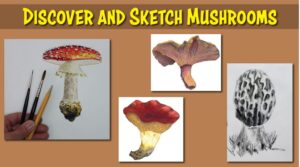
Learn more about the Discover and Sketch Mushrooms online course HERE or buy the online course directly HERE

(14-day money-back guarantee)