For those who dream of drawing wildlife with incredible realism, one of the most important skills you can develop is learning to truly SEE your subject in grayscale!
For example, I always complete value studies before moving on to color, as in this Bengal Tiger I illustrated for the cover of the Habitats of Asia book I illustrated (coming out next May by Princeton University Press) below.
|
|
Before you can convincingly capture the rich colors of a chameleon’s skin, the intricate patterns of a bird’s feathers, or the beautiful textures of a bear’s coat you need to understand how those features are shaped by light and shadow.
Think about it this way: If you can’t make an animal look three-dimensional using just a pencil or charcoal, adding color isn’t going to magically solve that problem.
|
|
Here’s another example; a Bighorn Sheep I illustrated (below). What makes an animal drawing look realistic isn’t simply capturing its markings, fur, or beautiful colors. It’s understanding the underlying three-dimensional forms, recognizing how light falls across those forms, and accurately interpreting the subtle transitions between highlights, mid-tones, and shadows.
|
|
I know how tempting it can be to jump straight into colored pencils, pastels, or watercolors. After all, color is exciting! It’s often what initially draws us to a particular animal or inspires us to create a piece of artwork.
But here’s something I want you to understand:
That’s why I teach my students to see and depict a full range of values in greyscale before rendering in color (as seen in my Blue-eared Kingfisher drawing demo below).
|
|
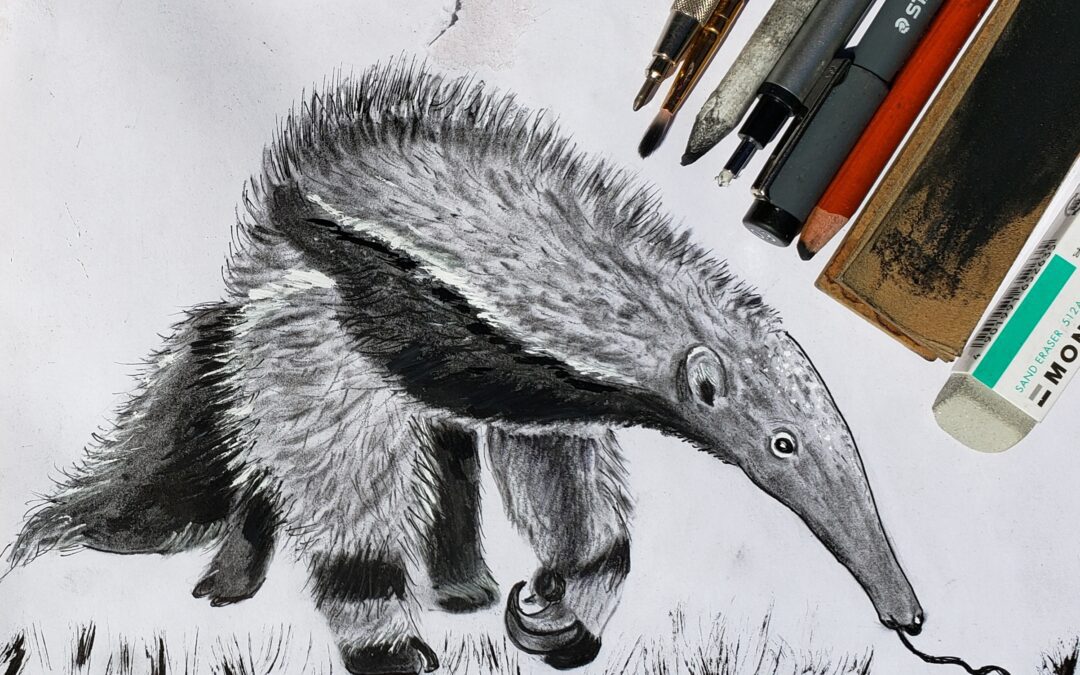
In fact, working in grayscale allows you to focus on what matters most without the added complexity of color. You begin to recognize subtle value changes, understand the structure beneath the surface, and train your eye to see your subject as a collection of three-dimensional forms rather than simply an outline filled with color.
And here’s the wonderful thing: These skills transfer to every art medium. Once you understand values, light, and form, you’ll have a much stronger foundation for tackling color whenever you’re ready.
|
|
This is exactly why my wildlife drawing membership places such an emphasis on graphite and charcoal. I want you to develop the fundamental skills that will transform the way you see and draw animals, helping you move beyond simply making a drawing look like an animal and toward creating artwork that feels life-like.
It’s not about limiting yourself to black and white. It’s about learning the skills that make realistic art possible.
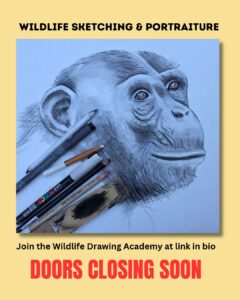
If you’ve been wanting to improve your wildlife drawings and develop the confidence to capture the incredible detail and realism of the animals you observe, I’d love to have you join us inside my new membership, The Wildlife Drawing Academy (enrollment closes soon)!